
Driving test tips Romford learners can use to prepare with confidence are about much more than remembering a test route. Passing your practical driving test requires safe decisions, effective observations, good vehicle control, and the ability to drive independently.
If you’re preparing for a driving test at Hornchurch or Goodmayes, these ten practical tips from Barka Driving School will help you identify what to practice before test day.
1. Understand What Happens During Your Driving Test
Knowing what to expect can help reduce uncertainty.
The practical car driving test in Great Britain includes an eyesight check, vehicle safety questions, general driving ability (including independent driving), and a reversing exercise.
For a standard car test, you’ll normally drive for around 35 minutes.
During the test, the examiner assesses whether you can drive safely and independently—not whether you can memorize particular roads.
Read the official DVSA driving test guide.
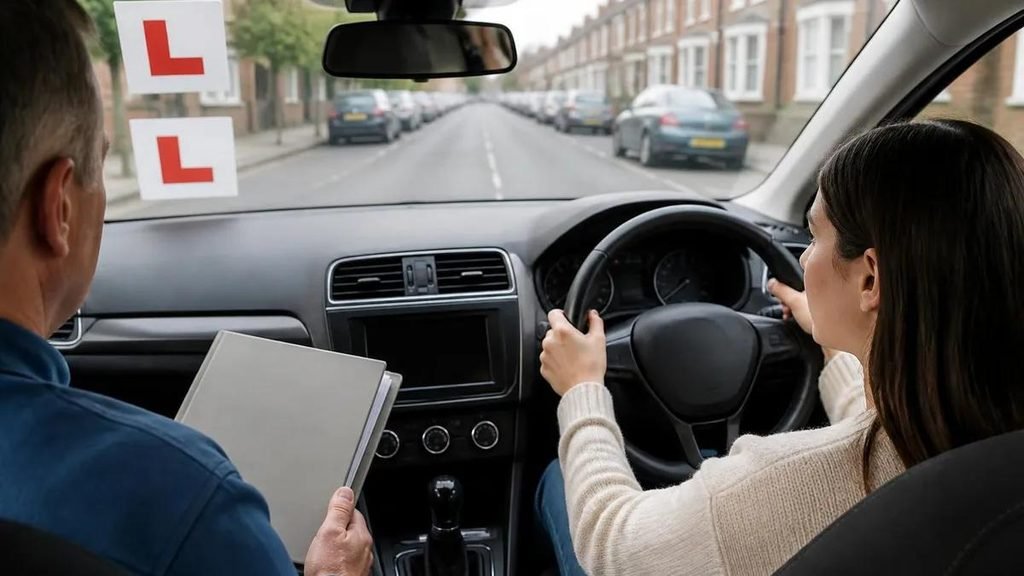
2. Practice Effective Observations at Junctions
One of the most important driving test tips is to make observations early enough to act safely.
When approaching a junction:
- Reduce your speed appropriately.
- Check for traffic, cyclists, and pedestrians.
- Assess whether the gap is genuinely safe.
- Look again as the situation changes.
- Avoid emerging before you have enough information.
The DVSA identifies ineffective observations at junctions as a leading reason for practical driving test failures.
Practice tip: During your lessons, explain what you can see, what might change and why you have chosen to wait or proceed.
3. Use Your Mirrors Before Changing Speed or Direction
Mirror checks should help you make decisions, not simply become a routine movement.
Before turning, changing lanes, slowing significantly, or moving away, check the relevant mirrors and respond to what you see.
For example, before changing lanes on a dual carriageway, consider whether another vehicle is approaching quickly in the adjacent lane.
Practice tip: Ask your instructor to help you recognize when mirror checks are needed and how they affect your actions.
4. Develop Confidence at Roundabouts
Roundabouts require planning, lane awareness, observation, and good judgement.
Approach at a suitable speed, follow the road signs and markings, and choose the correct position for your intended exit.
Watch for changing traffic conditions, including cyclists and vehicles approaching from other directions.
For learners preparing around Romford, practising different roundabout layouts can help build transferable skills.
Practice tip: Start with simpler roundabouts before progressing to more demanding layouts as your confidence and ability develop.
5. Practise Parking and Reversing Safely
Your examiner may ask you to complete a reversing exercise, such as parallel parking or parking in a bay.
Good manoeuvring involves:
- Effective all-round observations.
- Appropriate low-speed control.
- Accurate positioning.
- Responding safely to pedestrians and other vehicles.
- Correcting your position when necessary.
Remember that good observation matters just as much as parking accuracy.
Practice tip: Practise manoeuvres in different suitable locations rather than relying on one familiar parking space.
6. Improve Your Independent Driving Skills
During your practical test, you’ll follow directions from a sat nav, traffic signs or a combination of both.
The examiner is assessing whether you can plan ahead and make safe decisions without continuous guidance.
If you take a wrong turning, don’t panic. Taking the wrong route on its own is not a driving fault.
Focus on remaining safe and following the examiner’s instructions.
Practice tip: Ask your instructor to reduce verbal prompts gradually so you can develop independent judgement.
7. Prepare for Hornchurch and Goodmayes Test Centres
Learners from Romford and nearby areas may arrange practical tests at centres such as Hornchurch or Goodmayes.
Preparing well means becoming comfortable with a range of road conditions, not memorising a particular route.
Useful practice may include residential streets, busy junctions, multi-lane roads, speed changes and safe responses to unexpected situations.
The DVSA does not publish official test routes, and your examiner may direct you along different roads.
Practice tip: Discuss your chosen test centre with your instructor and agree which skills need improvement before your appointment.
Find the latest test centre information through the official GOV.UK test centre finder.
8. Take a Realistic Mock Driving Test
A mock test can help you understand how well you drive without constant instruction.
Ask your driving instructor to assess your observations, road positioning, speed choice, manoeuvres and response to hazards.
Afterwards, review any recurring issues and identify the most important skills to practise.
Don’t treat one successful mock test as a guarantee of passing. Aim for consistent, safe driving in different conditions.
9. Learn How Driving Faults Are Assessed
There are three categories of driving test faults:
Driving faults: Mistakes that are not potentially dangerous, although repeated faults may become serious.
Serious faults: Mistakes with the potential to be dangerous.
Dangerous faults: Mistakes involving actual danger.
To pass, you must make no serious or dangerous faults and no more than 15 driving faults.
A small mistake does not automatically mean you have failed. Continue driving safely and concentrate on what happens next.
Read the official driving test faults and results guidance.
10. Prepare Properly for Test Day
Before your driving test, check your booking confirmation and make sure you have the documents required by the DVSA.
Know where the test centre is located, allow enough travel time and confirm any use of your instructor’s vehicle well in advance.
Practise the vehicle safety questions and make sure you are familiar with the car’s controls.
Most importantly, take your test when you can drive independently and safely—not simply because you’ve managed to secure an appointment.
Driving Test Preparation with Barka Driving School
At Barka Driving School, we help learners develop the skills needed for confident, responsible driving.
Our tuition can focus on:
- Junctions and roundabouts.
- Mirrors, signalling and positioning.
- Hazard awareness and independent driving.
- Parking and reversing manoeuvres.
- Driving test preparation and mock-test feedback.
We offer driving lessons in Romford and surrounding Havering areas, with local pickup by prior arrangement.
Manual lessons: £35 per hour
Automatic lessons: £40 per hour
Standard lessons are two-hour sessions, subject to availability.
Explore our Driving Lessons in Romford or contact Barka Driving School to discuss your preparation.
Frequently Asked Questions
How many mistakes can I make during my driving test?
You can pass with up to 15 driving faults, provided you make no serious or dangerous faults. Repeated mistakes can become serious, so focus on consistently safe driving.
Can I fail for taking the wrong turning?
Taking a wrong turning by itself is not a driving fault. The important thing is to continue driving safely.
Are Hornchurch and Goodmayes driving test routes published?
No. The DVSA does not publish official driving test routes. Practising a variety of road types and situations is more useful than memorising a route.
How can I tell if I am ready for my driving test?
You should be able to drive safely in different conditions without your instructor giving instructions. A realistic mock test and honest feedback can help you assess your readiness.
Can nervous learners receive extra preparation?
Yes. Discuss the situations that make you nervous with your instructor. Targeted practice, clear feedback and greater familiarity with test requirements can help build confidence.
Ready to prepare for your driving test?
Contact Barka Driving School to discuss personalised driving lessons in Romford and Havering.
Call: 07300 364607
Website: https://barkadrivingschool.co.uk/
Safe driving skills matter more than memorising test routes. No driving school can guarantee a test pass.