
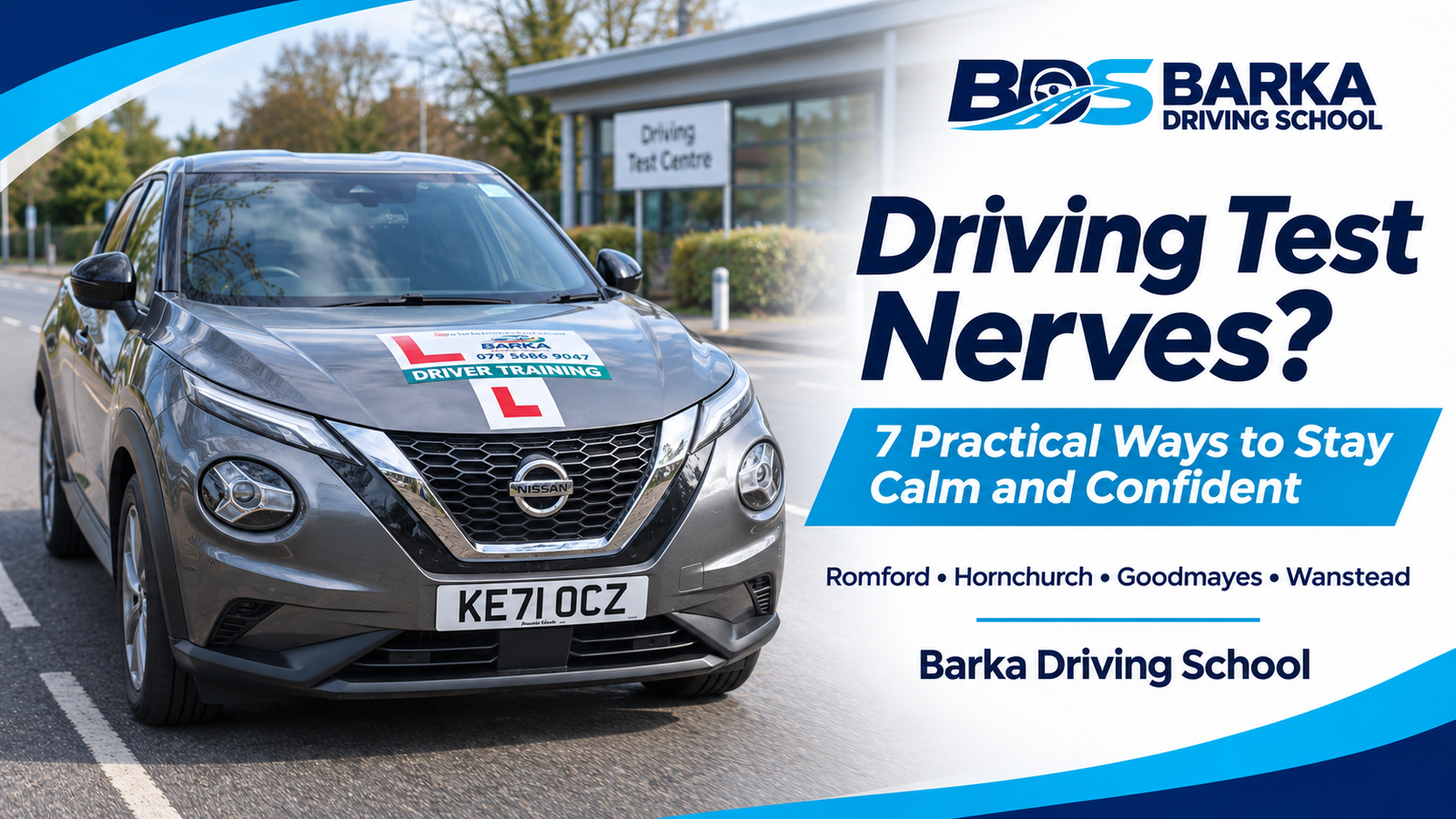
Driving test nerves can affect even well-prepared learner drivers. You might feel comfortable during your usual lessons but suddenly become anxious when you think about sitting beside an examiner.
Perhaps you’re worried about stalling, choosing the wrong lane at a roundabout or making a mistake during a manoeuvre. These concerns are understandable, particularly when you’ve invested time and money in learning to drive.
The good news is that there are practical ways to manage driving test nerves. You don’t need to be completely free from anxiety to drive safely. What matters is having the skills, preparation and judgement to deal with the road ahead.
At Barka Driving School, we help learners in Romford, Hornchurch, Goodmayes, Wanstead and surrounding areas develop confidence at a pace suited to their experience.
Here are seven things worth trying before your practical driving test.
1. Understand What the Driving Test Involves
Uncertainty can make driving test nerves worse. Knowing the structure of the test helps you prepare for what is expected.
A practical car driving test in Great Britain includes:
- An eyesight check.
- Vehicle safety questions.
- General driving, including independent driving.
- A reversing exercise.
- An emergency stop in some tests.
Your examiner wants to see whether you can drive safely and independently. They are not looking for a perfect performance.
You can familiarise yourself with the test using the official GOV.UK driving test guide.
What to practise
Ask your instructor to explain the test format and give you opportunities to drive with fewer verbal prompts.
If you understand what the examiner is assessing, you can concentrate on your driving rather than worrying about unexpected instructions.
2. Take a Mock Driving Test Before the Real One
A mock driving test is one of the most useful ways to assess your readiness.
During a normal lesson, your instructor may remind you to check mirrors, anticipate a hazard or adjust your road position.
A mock test allows you to practise making those decisions independently.
It also gives you an opportunity to experience a more formal driving assessment.
Make the feedback useful
After the mock test, discuss:
- Whether your observations were effective.
- How you approached junctions and roundabouts.
- Whether you maintained appropriate speed and positioning.
- How you responded to unexpected situations.
- Which skills still need further practice.
Don’t worry if your first mock test identifies several weaknesses. The purpose is to find out what needs improvement before the actual assessment.
3. Work on the Driving Situations That Make You Nervous
Different learners worry about different things.
Some feel uneasy at large roundabouts. Others struggle with hill starts, parking manoeuvres or busy junctions.
Instead of repeatedly practising everything, tell your instructor which situations are causing concern.
A practical example: roundabouts
If roundabouts make you nervous, your instructor can help you work through them gradually.
Start by recognising signs and road markings. Then practise approaching at an appropriate speed, choosing the correct lane and judging whether it is safe to enter.
As you become more comfortable, you can progress to more complex layouts.
The aim is not to memorise one roundabout. It is to develop the judgement needed to handle unfamiliar ones.
Learners preparing around Hornchurch, Goodmayes and Wanstead can benefit from experience across different road conditions, provided the practice is appropriate to their ability.
4. Learn How to Recover After a Small Mistake
One of the biggest causes of driving test anxiety is the belief that one mistake means automatic failure.
That isn’t necessarily true.
During your practical test, faults are assessed as driving faults, serious faults or dangerous faults.
To pass, you must make no serious or dangerous faults and no more than 15 driving faults.
For example, taking a wrong turning does not automatically mean you have failed. What matters is how safely you respond.
If you make a small mistake, concentrate on the road ahead rather than trying to work out whether you’ve passed.
You can read about driving test faults and results on GOV.UK.
A useful habit
If something doesn’t go as planned, focus on three things:
- Maintain safe control of the vehicle.
- Observe the developing traffic situation.
- Make your next decision calmly.
You cannot undo a previous mistake, but you can continue to drive safely.
5. Prepare Yourself Before Test Day
Good preparation includes more than driving practice.
The day before your test, check your appointment details and confirm where you need to go.
Make sure your provisional driving licence is ready and arrange any required glasses or contact lenses.
If you’re using your instructor’s vehicle, confirm the arrangements in advance.
Try to get a reasonable night’s sleep and avoid rushing to the test centre.
Give yourself enough time for the journey so that unexpected traffic does not create unnecessary pressure.
Test-day checklist
- Check your appointment confirmation.
- Bring your photocard provisional driving licence.
- Bring glasses or contact lenses if required.
- Know where your test centre is located.
- Confirm your vehicle arrangements.
- Arrive at the time specified in your booking instructions.
If you have any doubts about the requirements, check the latest information on GOV.UK.
6. Use Simple Techniques to Manage Anxiety
When you’re nervous, you may notice yourself gripping the steering wheel too tightly, rushing decisions or focusing on what might go wrong.
Before your test, take a few moments to settle yourself.
You could try breathing slowly, relaxing your shoulders and focusing on one task at a time.
During the test, think about what the road requires now rather than what might happen at the end.
For example, when approaching a junction, concentrate on your observations, road position, speed and whether the situation is safe.
If you don’t understand an examiner’s instruction, you can ask them to repeat it.
Remember
Confidence isn’t about never feeling nervous. It’s about having enough preparation to make safe decisions even when you feel under pressure.
7. Take Your Test When You Can Drive Independently
Securing a test appointment is not the same as being ready to take the test.
Before your appointment, ask yourself whether you can consistently:
- Drive safely without frequent instructor prompts.
- Recognise and respond to developing hazards.
- Approach junctions and roundabouts appropriately.
- Use mirrors effectively.
- Control the vehicle during manoeuvres.
- Follow directions while making safe decisions.
Your instructor can help you assess your progress and identify any remaining weaknesses.
The DVSA also provides a Ready to Pass guide to help learners understand when they are prepared for their test.
Preparing for a Driving Test at Hornchurch, Goodmayes or Wanstead?
Learners often worry about unfamiliar roads around their chosen test centre.
Although experience in an area can be useful, memorising particular routes should not be your main preparation strategy.
The DVSA does not publish official driving test routes.
Instead, practise the driving skills needed in a variety of situations, including busy junctions, residential roads, roundabouts and roads with changing speed limits.
Discuss the specific test centre with your instructor and agree a realistic preparation plan.
At Barka Driving School, we provide driving tuition for learners across Romford, Hornchurch, Goodmayes, Wanstead, Brentwood, Tilbury and nearby areas, subject to availability and agreed pickup arrangements.
How Barka Driving School Can Help Nervous Learners
Learning to drive should be a supportive process.
At Barka Driving School, lessons are adapted to your experience, progress and the situations you find challenging.
We can help you develop:
- Greater confidence with car controls.
- Better observations and road awareness.
- Safer judgement at junctions and roundabouts.
- Independent driving skills.
- Driving test preparation through targeted practice and mock-test feedback.
Manual driving lessons are £35 per hour and automatic driving lessons are £40 per hour. Standard sessions last two hours.
Explore our Driving Lessons in Romford or contact Barka Driving School to discuss your experience and availability.
Frequently Asked Questions
Is it normal to feel nervous before a driving test?
Yes. Many learners feel some anxiety before being assessed. Preparation, experience and supportive instruction can help you manage it.
Will I fail if I stall during my driving test?
Not automatically. It depends on the circumstances and whether the mistake creates a safety issue. Concentrate on recovering safely and maintaining awareness of surrounding traffic.
Can I ask the examiner to repeat an instruction?
Yes. You can ask the examiner to repeat directions if you haven’t understood them.
Do I need to know every test route?
No. Official DVSA test routes are not published. You should prepare to drive safely on a variety of roads and respond appropriately to unfamiliar situations.
How many mock driving tests should I take?
There is no fixed number. Your instructor can recommend mock assessments based on your progress and the consistency of your independent driving.
Can nervous learners book driving lessons with Barka?
Yes. We welcome nervous learners and can discuss an appropriate training plan based on your previous experience and individual needs.
Ready to Feel More Confident Behind the Wheel?
If driving test nerves are affecting your preparation, speak to Barka Driving School.
We offer patient, personalised driving lessons with a focus on safe driving skills, practical experience and steady progress.
Call 07300 364607 to discuss your lessons.
Visit Barka Driving School to learn more.
Your goal isn’t simply to pass a driving test. It’s to become a safe, capable and independent driver.